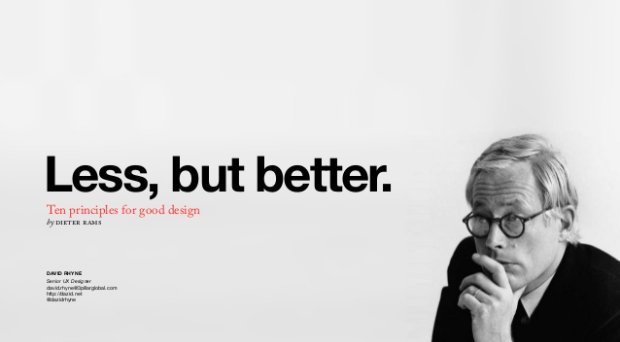
Dieter Rams (born 20 May 1932 in Wiesbaden, Hessen) is a German industrial designer closely associated with the consumer products company Braun and the Functionalist school of industrial design. His unobtrusive approach and belief in “less but better” design generated a timelessness nature in his products and have influenced the design of many products, which also secured Rams worldwide recognition and appreciation. The work and principles of Dieter design thinking influenced Johny Ives work at Apple. Rams says that Apple is one of only a handful of companies existing today that design products according to Rams’ ten principles of “good design (see below).
Dieter articulates much better than I can ever do in regards to the experience that a colleague and I wanted us to create for our clients in regards to the digital user experience with our institution. The three most important aspects for me are user processes, emotional connection and to use Dieter’s words Less, but Better.
User Processes
We strived to create some amazing forward thinking processes. Processes that create efficiency and gives back the user time to think about the real important aspects of their day, week, month. A simple example is in our FX alert prototype … immediate chat with a Credit Officer, follow up alerts and action tracking
Emotional connection
How are we going to compete with all other single bank and multi bank platforms? How do we have the individual stay connected to our platform as much as possible? We need to somehow create and make our banking an emotional experience
Less, but Better
This really says it all and is so pure. We should take this design principle not just for our UX but for everything we do. Our writing, our meetings, our possessions and of course our design. This principle is very hard, we experience this when we try and take a 3 page document in shrink it down to 1/2 a page.
It is the above three aspects that make me love certain products. We strived to do the same for the Digital product we were developing.
Dieter Rams Ten Principles of “Good Design”
- Good Design Is Innovative : The possibilities for innovation are not, by any means, exhausted. Technological development is always offering new opportunities for innovative design. But innovative design always develops in tandem with innovative technology, and can never be an end in itself.
- Good Design Makes a Product Useful : A product is bought to be used. It has to satisfy certain criteria, not only functional but also psychological and aesthetic. Good design emphasizes the usefulness of a product while disregarding anything that could possibly detract from it.
- Good Design Is Aesthetic : The aesthetic quality of a product is integral to its usefulness because products are used every day and have an effect on people and their well-being. Only well-executed objects can be beautiful.
- Good Design Makes A Product Understandable : It clarifies the product’s structure. Better still, it can make the product clearly express its function by making use of the user’s intuition. At best, it is self-explanatory.
- Good Design Is Unobtrusive : Products fulfilling a purpose are like tools. They are neither decorative objects nor works of art. Their design should therefore be both neutral and restrained, to leave room for the user’s self-expression.
- Good Design Is Honest : It does not make a product more innovative, powerful or valuable than it really is. It does not attempt to manipulate the consumer with promises that cannot be kept
- Good Design Is Long-lasting : It avoids being fashionable and therefore never appears antiquated. Unlike fashionable design, it lasts many years – even in today’s throwaway society.
- Good Design Is Thorough Down to the Last Detail : Nothing must be arbitrary or left to chance. Care and accuracy in the design process show respect towards the consumer.
- Good Design Is Environmentally Friendly : Design makes an important contribution to the preservation of the environment. It conserves resources and minimises physical and visual pollution throughout the lifecycle of the product.
- Good Design Is as Little Design as Possible : Less, but better – because it concentrates on the essential aspects, and the products are not burdened with non-essentials. Back to purity, back to simplicity.
https://www.youtube.com/watch?v=RWoprlPMBnA
#thoughtfortheweek

 thought for the week