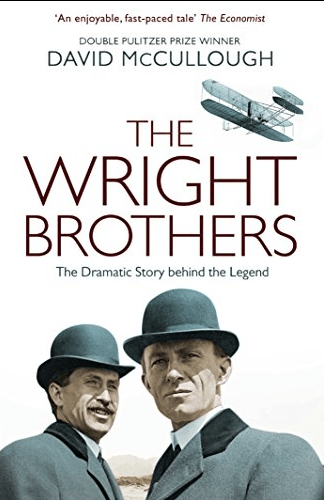
I read a review of the book The Wright Brothers by David McCullough, author of 1111 major books and winner of two Pulitzer Prizes, which made me want to read the book.
What caught my eye of the review was that the Wright Brothers would have fierce conversations and debates with each other, yet somehow they stayed together as a team to achieve one of the most amazing accomplishments in the 20th century. This interested me because there have been so many times where I either have seen or been involved in fierce ‘debates’ (more on the use of the word ‘debate’ later) with senior colleagues or peers, and I wanted to know how the two brothers managed these situations, and what I can learn from them.
As with any David McCullough books, it is well worth reading. The Wright Brothers story starts from humble beginnings, fighting through trials and tribulations, being resilient in defeat, never diverging from the overall goal and outcome and continuing to stay humble, even after fame and success.
So what did I learn on how to have fierce debates or conversations, yet continuing to respect each other and stay together as a team? Unfortunately, the book did not really expand on this as it just was who they were. One excerpt from the book is from Charlie Taylor, their first employee at their bicycle shop:
“According to Charlie Taylor, they were never really mad at each other. One morning after one of their ‘hottest’ exchanges, he had only just opened the shop at 7AM as usual when Orville came in saying he “guessed he’d be wrong and that they ought to do it Will’s way.” Shortly after, Wilbur arrived to announce that he had been thinking it over and “perhaps, Orv was right.” The point was, said Charlie, “when they were through … they knew where they were and could go ahead with the job.”
I get the following out of this description
- At times, we just need time to process the conversation. During the conversation, we may not be in the right ‘emotional’ state of mind, but time will help us process our and other’s views and thoughts. We can always go back to continue the conversation,
- Listening. There is just not enough emphasis on the power of listening, and being heard. This is not easy, it takes a lot of work. Two actions that I have done to help me really learn this skill
- Don’t juggle your prejudices. We all have prejudices. Before forming an opinion, ask yourself if you are juggling your prejudices.
- Instead of interrupting the speaker, write your thoughts or questions on a piece of paper so you can remember and ask later. This helps you focus on what is being said, as opposed to trying to remember what you want to say. Sometimes the person you are speaking with needs time to bring together their point or story, so listen first
I also have learned to set the situation and mindset to have a dialogue as opposed to a debate or discussion
- Debate – a formal discussion on a particular matter in a public meeting or legislative assembly, in which opposing arguments are put forward and which usually ends with a vote. In other words, someone has to win
- Discussion – the action or process of talking about something in order to reach a decision or to exchange ideas … but in a work setting, it is usually a lopsided discussion between a supervisor and subordinate.
- Dialogue – take part in a conversation or discussion to resolve a problem. I just find this word being more well balanced and not to be lopsided.
For your next dialogue, or whatever words you want to use or however you want to describe it, just make sure everyone is listening, especially you if you are viewed as a leader, everyone has a say and you stay focused on the topic at hand (don’t go down the wrong rabbit hole)
Here are some other experts fo the book which I found to be Powerful Ideas:
- Wilbur – If I were giving a young man advice as to how he might succeed in life, I would say to him, pick out a good father and mother and begin life in Ohio.
- Orville – the greatest thing in our favor was growing up in a family where there was always much encouragement to intellectual curiosity
- It was not luck that made them fly: it was hard work and common sense: they put their whole heart and soul and all their energy into an idea and they had the faith
- Orville & Wilbur – “The best dividend on the labor invested, have invariably come from seeking more knowledge rather than power
- Bishop Wright (father) – “We learn much by tribulation, and by adversity our hearts are made better.”
- Post an argument, a letter written by Wilbur to Octave Chantue (was a French-American civil engineer and aviation pioneer. He advised and publicized many aviation enthusiasts, including the Wright brothers. At his death, he was hailed as the father of aviation and the initial concepts of the heavier-than-air flying machine) – Plainly wishing the dispute to be resolved, Wilbur closed his note to Chantue on a warmer note. “If anything can be done to straighten matters out to the satisfaction of both you and us, we are not only willing, but anxious to do our parts.
- I believe that unless we understand exactly how you felt, and you can understand how we felt, our friendship would tend to grow weaker instead of stronger. Through ignorance or thoughtlessness, each would be touching the other’s sore spots and causing unnecessary pain. We prize to highly the friendship which meant so much in the years of our early struggles to willingly see it worn away by uncorrected misunderstandings, which might be corrected by frank discussions.

 thought for the week